Villanova 5-Out Motion Offense: A Comprehensive Breakdown
Villanova’s renowned 5-out motion offense, detailed in resources like the Villanova pdf guides, emphasizes constant player movement and strategic cuts for optimal scoring opportunities.
Historical Context & Harry Perretta’s Influence
Harry Perretta, the long-time head coach of Villanova’s women’s basketball team, is credited with pioneering the 5-out motion offense. His innovative approach, documented in various Villanova pdf resources and coaching clinics, prioritized player freedom and continuous movement. Perretta’s system wasn’t about rigid plays, but rather teaching players how to play, emphasizing intelligent cuts and reacting to defensive weaknesses.

Laura Kurz, a key assistant under Perretta, played a vital role in refining and implementing the offense. Her detailed 5-out cutting drills, now widely circulated, showcase the foundational skills required for success. The offense’s evolution reflects Perretta’s belief in empowering players to make quick decisions, creating a dynamic and unpredictable attack, a philosophy later embraced and expanded upon by Jay Wright.
Jay Wright’s Offensive Philosophy & Efficiency
Jay Wright, building upon Harry Perretta’s foundation, elevated Villanova’s 5-out motion offense to national prominence. Wright’s philosophy centered on maximizing offensive efficiency through spacing, ball movement, and player skill development – principles thoroughly outlined in Villanova pdf playbooks. He prioritized intelligent decision-making and reading the defense, empowering players to exploit mismatches and create scoring opportunities.
Villanova consistently ranked among the nation’s most efficient offenses under Wright, demonstrating the system’s effectiveness. His teams weren’t reliant on isolation plays or dominant post players, but rather on collective movement and unselfish play. This approach, detailed in scouting reports and film analysis, made Villanova a challenging opponent for any defense.
Core Principles of the 5-Out Motion
The Villanova 5-out motion offense, as detailed in available pdf resources, revolves around several core principles. Continuous player movement, including cuts and screens, is paramount, creating passing lanes and disrupting defensive assignments. Proper spacing – maintaining distance between players – is crucial for driving lanes and preventing defensive congestion.
Decision-making based on defensive reactions is also key; players must read the defense and react accordingly. The offense emphasizes ball movement, aiming for quick passes to exploit openings. Finally, filling empty spots after cuts ensures continuous flow, preventing stagnation, and maintaining offensive pressure – all concepts thoroughly explained in Villanova’s offensive manuals.
Spacing and Player Positioning
Villanova’s 5-out motion offense, as illustrated in instructional pdfs, prioritizes optimal spacing. Players occupy positions along the perimeter – corners, wings, and the top of the key – maintaining consistent distance; This spacing creates driving lanes for penetration and passing angles for ball movement.
Positioning isn’t static; players continuously relocate based on cuts and defensive reactions. The goal is to avoid congestion and ensure each player has a clear path to the basket or an open shot. Filling vacated spots after cuts is vital for maintaining offensive flow and preventing defensive recovery, concepts emphasized within Villanova’s detailed offensive schemes.
Continuous Movement & Cutting
Villanova’s 5-out motion, detailed in available pdf resources, thrives on relentless player movement. Cutting is fundamental – players constantly slice through the defense, seeking openings and disrupting defensive assignments. These cuts aren’t random; they’re purposeful, often triggered by ball movement or defensive vulnerabilities.
Corner cuts, as highlighted in instructional materials, are a key component, creating scoring opportunities or forcing defensive rotations. Wing replacements ensure continuous perimeter action. The pdf guides emphasize that even without immediate scoring chances, cuts fill spaces, enabling the offense to transition seamlessly into the next action, maintaining constant pressure.
Decision-Making & Reading the Defense

Villanova’s 5-out motion, as outlined in the pdf resources, isn’t a rigid set of plays, but a system demanding astute decision-making. Players must constantly read defensive positioning, identifying mismatches and exploiting weaknesses. The pdf guides stress recognizing when to drive, pass, or shoot based on defender reactions.
If a primary option isn’t available, players are trained to react – cutting to the corner or filling vacated spaces. Recognizing opportunities for post seals, or reversing the pivot to exploit favorable matchups, are crucial. Successful execution relies on players’ ability to anticipate and react, making quick, intelligent choices within the offensive flow.
Key Actions & Reads within the Offense
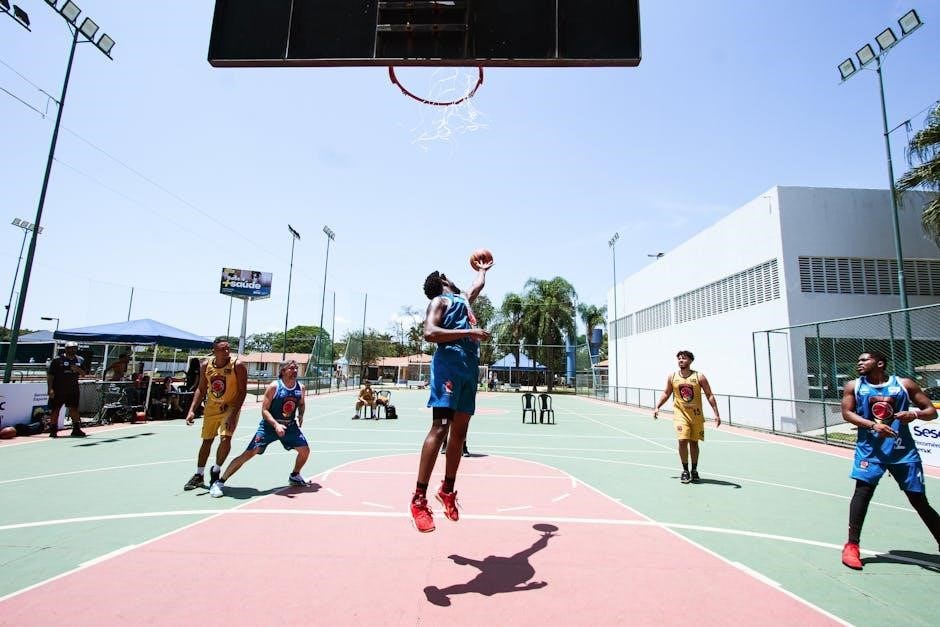
Villanova’s 5-out motion, detailed in the pdf, features actions like the flex option, corner cuts, and post seals, requiring players to read defensive responses.
The Initial Flex Option & Reads
The initial action often involves a flex cut, initiating the offense’s flow as outlined in the Villanova 5-out motion pdf. If the initial pass isn’t available, players execute continuous cuts through to the corner, with wing replacements maintaining spacing. Players must read how the defense reacts; a key read is whether the defender overplays the initial cut, opening up a passing lane.
If a mismatch appears inside, the pivot player can seal their defender, creating an easy scoring opportunity. Even if the flex doesn’t yield an immediate shot, it ensures all five spots are filled, allowing for seamless transitions into subsequent offensive actions. This continuous movement is central to the system’s effectiveness.
Corner Cuts & Wing Replacements
Corner cuts are fundamental to Villanova’s 5-out motion, detailed in available pdf resources, creating passing angles and stressing the defense. When a player cuts to the corner, a teammate from the wing immediately replaces them, maintaining crucial offensive spacing. This replacement isn’t static; it’s a continuous cycle of movement, keeping defenders engaged and preventing help rotations.
These cuts and replacements force defensive communication and reactions. Players must read the defender’s positioning, anticipating passing lanes and potential openings. Successful execution relies on precise timing and understanding of the offensive flow, ensuring constant action and opportunities for scoring.
Post Seals & Inside-Out Play
Villanova’s 5-out motion, as outlined in coaching pdfs, incorporates post seals when a mismatch arises, creating high-percentage scoring chances. A player will attempt to seal their defender, establishing position near the basket for an entry pass. If the seal isn’t available, the offense swiftly transitions to an inside-out play, kicking the ball back out to open shooters on the perimeter.
This versatility keeps the defense guessing. The threat of the post opens up driving lanes and perimeter shots. Drawing the defender inside can also create opportunities to draw fouls, adding another dimension to the offense.
Utilizing Mismatches & Drawing Fouls
Villanova’s 5-out motion, detailed in available pdf resources, actively seeks and exploits defensive mismatches. Players are empowered to attack weaker defenders, driving to the basket or creating scoring opportunities through isolation. A key component is aggressively attacking to draw fouls, particularly when a post player receives the ball inside.
Coaches emphasize initiating contact and finishing strong. The offense aims to get opponents into foul trouble, potentially limiting their key players. This strategic approach, highlighted in Villanova’s offensive philosophy, maximizes scoring and disrupts the opposing team’s defensive structure.
Reversing the Pivot & Offensive Flow
Villanova’s 5-out motion, as illustrated in instructional pdf materials, frequently utilizes a reversed pivot to maintain offensive fluidity and disrupt defensive positioning. This action allows the ball handler to change direction, creating new passing lanes and driving opportunities. Reversing the pivot also helps to reset the offense if the initial action is stifled.
The continuous movement and passing inherent in the system ensure the offensive flow isn’t easily contained. Players are trained to read the defense and react accordingly, constantly shifting and creating advantageous matchups; This dynamic approach keeps defenders guessing and opens up scoring possibilities.

Drills & Skill Development
Villanova’s 5-out motion offense, per pdf resources, requires focused drills on cutting, passing, and spacing—emphasized by Laura Kurz’s curriculum for player proficiency.
5-Out Cutting Drills (Laura Kurz’s Focus)
Laura Kurz’s drills, detailed within Villanova’s 5-out motion offense pdf materials, prioritize sharp, decisive cuts and continuous movement without the ball. These drills, stemming from Harry Perretta’s teachings, focus on timing and reading defender positioning. A core element involves players practicing corner-to-corner and wing-to-wing cuts, emphasizing a quick first step and maintaining spacing.
Drills also incorporate variations where players react to different defensive scenarios, learning to cut through openings or relocate to create passing lanes. Kurz’s approach stresses the importance of filling vacated spots immediately, ensuring the offense maintains its structure and flow. Repetition and game-speed execution are key components, building muscle memory and instinctive reactions for effective offensive play.
Passing & Receiving Drills for Motion
Villanova’s 5-out motion offense, as outlined in the associated pdf resources, demands precise and timely passing. Drills emphasize quick ball movement, utilizing sharp angles and skip passes to exploit defensive weaknesses. Players practice receiving passes on the move, focusing on proper footwork and securing the ball with soft hands. A key drill involves continuous passing sequences, simulating game-like scenarios and building chemistry.
Emphasis is placed on making decisive passes, avoiding hesitation, and reading the defender’s positioning. Receiving drills incorporate various techniques, including jump stops and pivoting, preparing players for immediate scoring opportunities or continued ball movement. These drills aim to foster confident and efficient ball handling within the offensive system.
Footwork & Spacing Drills
Villanova’s 5-out motion offense, detailed within the available pdf guides, hinges on impeccable footwork and precise spacing. Drills focus on maintaining optimal distances between players, creating passing lanes and driving opportunities. Players practice V-cuts, basket cuts, and quick changes of direction, enhancing their ability to create separation from defenders. Emphasis is placed on continuous movement, avoiding standing still, and reacting to defensive shifts.
Spacing drills involve designated zones and require players to consistently occupy those areas, ensuring proper floor balance. These exercises build muscle memory and promote instinctive positioning, crucial for the offense’s fluidity and effectiveness. Proper footwork allows for efficient cuts and quick reactions.
Adapting the Offense
Villanova’s 5-out motion, as outlined in the pdf resources, can be modified to a 4-out set for simpler execution, particularly with younger or less experienced teams.
4-Out Variations & Simplification for Youth Teams
Transitioning to a 4-out formation from Villanova’s 5-out motion, detailed in available pdf guides, offers a valuable simplification strategy for youth teams. This adjustment reduces spacing demands and complexity, making the offense more accessible. The core principles of continuous movement and cutting remain, but with fewer players involved in initial actions.
Focusing on basic motion rules—filling spots, making timely cuts, and passing to open teammates—becomes paramount. Coaches can initially limit options, emphasizing the flex action and corner cuts. The 4-out allows for easier post entry, as highlighted in resources, enabling teams to develop inside-out play. Simplifying reads and decision-making builds foundational skills before introducing more intricate concepts. This phased approach fosters understanding and confidence.
Adjusting to Defensive Pressure
Villanova’s 5-out motion, as outlined in various pdf resources, thrives on exploiting defensive weaknesses, but requires adjustments when facing increased pressure. Against full-court presses, quick decision-making and accurate passing are crucial to break the initial trap. Utilizing skip passes and reversing the ball swiftly can disrupt the defense’s momentum.
When confronted with aggressive half-court defense, players must prioritize spacing and continuous movement to create passing lanes. Recognizing and attacking mismatches, or drawing fouls through smart drives, becomes essential. The offense’s fluidity allows for quick reversals of the pivot, opening up new angles and opportunities. Maintaining composure and executing fundamental skills under pressure are key to sustained success.
Personnel Considerations & Role Definition
Villanova’s 5-out motion, detailed in available pdf breakdowns, isn’t a rigid system; it demands adaptable players. Success hinges on having five players capable of handling the ball, passing accurately, and shooting from the perimeter. While specific roles aren’t strictly defined, players must understand their strengths and contribute accordingly.
Identifying a primary playmaker is beneficial, but the offense encourages shared responsibility. Players need basketball IQ to read defenses and make appropriate cuts. Post players, even in a 5-out, must be skilled at sealing and finishing inside. Coaches should tailor the offense to their team’s personnel, emphasizing individual development within the system’s framework.
Film Study & Scouting Applications
Villanova’s 5-out motion, analyzed through pdf film study, requires scouting opponents’ defensive tendencies to exploit weaknesses and adjust offensive strategies effectively.

Analyzing Villanova Game Film
Detailed analysis of Villanova game film, often accessible through resources like the 5-out motion offense Villanova pdf guides, reveals the nuanced execution of their system. Focus on observing initial flex options and subsequent reads, noting how players react to defensive pressure. Pay close attention to corner cuts and wing replacements, identifying patterns in player movement and spacing.
Observe how Villanova utilizes post seals and inside-out play, particularly when exploiting mismatches. Film study should also highlight decision-making processes – when players drive, pass, or shoot. Crucially, analyze how they reverse the pivot and maintain offensive flow even when the initial action is disrupted. Understanding these elements provides a comprehensive view of the offense’s effectiveness.
Scouting Opponent Defenses & Adjustments
Effective scouting, informed by resources like the 5-out motion offense Villanova pdf, centers on identifying how opponents defend the core principles. Does the defense aggressively deny initial cuts, or do they sag, allowing driving lanes? Note their response to flex actions – do they switch, hedge, or show?
Adjustments might involve altering cutting angles to exploit defensive weaknesses, or utilizing quick ball reversals to punish over-aggressive help. Recognizing tendencies to double-team or rotate allows for pre-emptive passing to open shooters. The pdf guides often emphasize adapting to pressure, potentially simplifying actions or increasing off-ball screening to create advantages.
Implementing Game Strategy Based on Film
Leveraging film study, guided by the 5-out motion offense Villanova pdf, allows coaches to pinpoint specific moments for strategic implementation. Identify opponent weaknesses – perhaps a slow rotation on corner cuts or vulnerability to inside-out play. Designate specific actions to exploit these flaws, like emphasizing post seals against a mismatch, as detailed in the pdf.
Game planning should incorporate counters to anticipated defensive adjustments. If opponents hedge screens, prepare for quick slips or pop reads. The pdf resources highlight the importance of recognizing and reacting to defensive pressure, ensuring players understand their roles in various scenarios.

Google Docs & Collaborative Analysis
Google Docs facilitates collaborative playbook creation, allowing coaches to diagram Villanova’s 5-out motion offense, share the pdf insights, and annotate film together.
Utilizing Google Docs for Play Diagrams
Google Docs proves invaluable for visually mapping Villanova’s intricate 5-out motion offense. Coaches can leverage its drawing tools to create clear play diagrams, illustrating key cuts, screens, and player movements directly within the document. Importing screenshots from the Villanova pdf resources, detailing specific actions like the initial flex option or corner cuts, enhances clarity.
Furthermore, Google Docs’ collaborative features allow multiple coaches to simultaneously contribute to playbook development, ensuring everyone is aligned on offensive strategies. Utilizing shapes and lines, teams can visually represent spacing and passing lanes, mirroring the offense’s emphasis on continuous motion. This digital format offers easy accessibility and modification, streamlining the preparation process.
Sharing & Editing Playbooks
Google Docs facilitates seamless playbook sharing among coaching staff, vital when implementing Villanova’s 5-out motion offense. Access permissions control who can view, comment, or directly edit play diagrams derived from the Villanova pdf materials. Real-time collaboration allows for immediate feedback and adjustments, ensuring the playbook remains current and effective.
Version history tracks all changes, enabling coaches to revert to previous iterations if needed. This collaborative environment fosters a unified understanding of the offense’s nuances, from initial flex options to post seals. The ease of sharing and editing streamlines the process of adapting the playbook to specific opponents or personnel.
Film Breakdown & Annotation within Google Docs
Google Docs allows direct integration of screenshots and video links from Villanova game film, crucial for analyzing the 5-out motion offense in action. Coaches can annotate these visuals, highlighting key cuts, screens, and player positioning as detailed in the Villanova pdf resources. Comments can be added directly to specific moments, fostering focused discussion among the team.
This feature streamlines the process of identifying offensive strengths and weaknesses, and scouting opponent defensive tendencies. By linking film clips to playbook diagrams within the same document, coaches create a comprehensive learning tool. This integrated approach enhances player understanding and accelerates offensive execution.